Mastering the 4 Pillar SMETA Audit on the Factory Floor
The auditor arrives at the gate, clipboard in hand, and the familiar tension ripples through the facility. You have spent weeks chasing down signatures, double-checking the training logs, and ensuring the payroll records are beyond reproach. But as any shift supervisor knows, the real challenge of a 4 pillar smeta audit is not the paperwork in the office; it is the reality of the floor. It is the fire exit in the packing area that someone propped open with a pallet ten minutes ago, or the eye-wash station that has slowly become a shelf for discarded coffee cups.
A 4 pillar smeta audit is a rigorous examination of your site vis-à-vis four key areas: Labour Standards, Health and Safety, Environment, and Business Ethics. While the first and last pillars are often heavy on documentation, the middle two are where the daily battle for compliance is won or lost. Maintaining these standards requires a move away from the façade of 'audit readiness' toward a permanent state of operational excellence. It means ensuring that every machine guard, every spill kit, and every shadow board looks exactly as it should, every single hour of the day.
The Visual Reality of Health and Safety
Health and Safety is often the most visible part of an audit. An auditor is trained to look for patterns of neglect. They are not just looking for a missing fire extinguisher; they are looking for the dust on top of it, which suggests it hasn't been touched or inspected in months. They are looking for the 'temporary' electrical cord snaked across a walkway, taped down with duct tape that is already fraying at the edges. These are the physical manifestations of your safety culture.
To manage this effectively, you must define what 'correct' looks like for every high-risk area. Take the lockout-tagout (LOTO) station as an example. It is not enough to know that you have one. The standard must be that every padlock is in its designated slot, every tag is crisp and legible, and the station is completely unobstructed. When a supervisor walks past that station, they shouldn't have to consult a mental list; the deviation should be visually obvious. This is where many manufacturing and production floors struggle. They rely on the memory of the supervisor rather than a fixed visual standard.
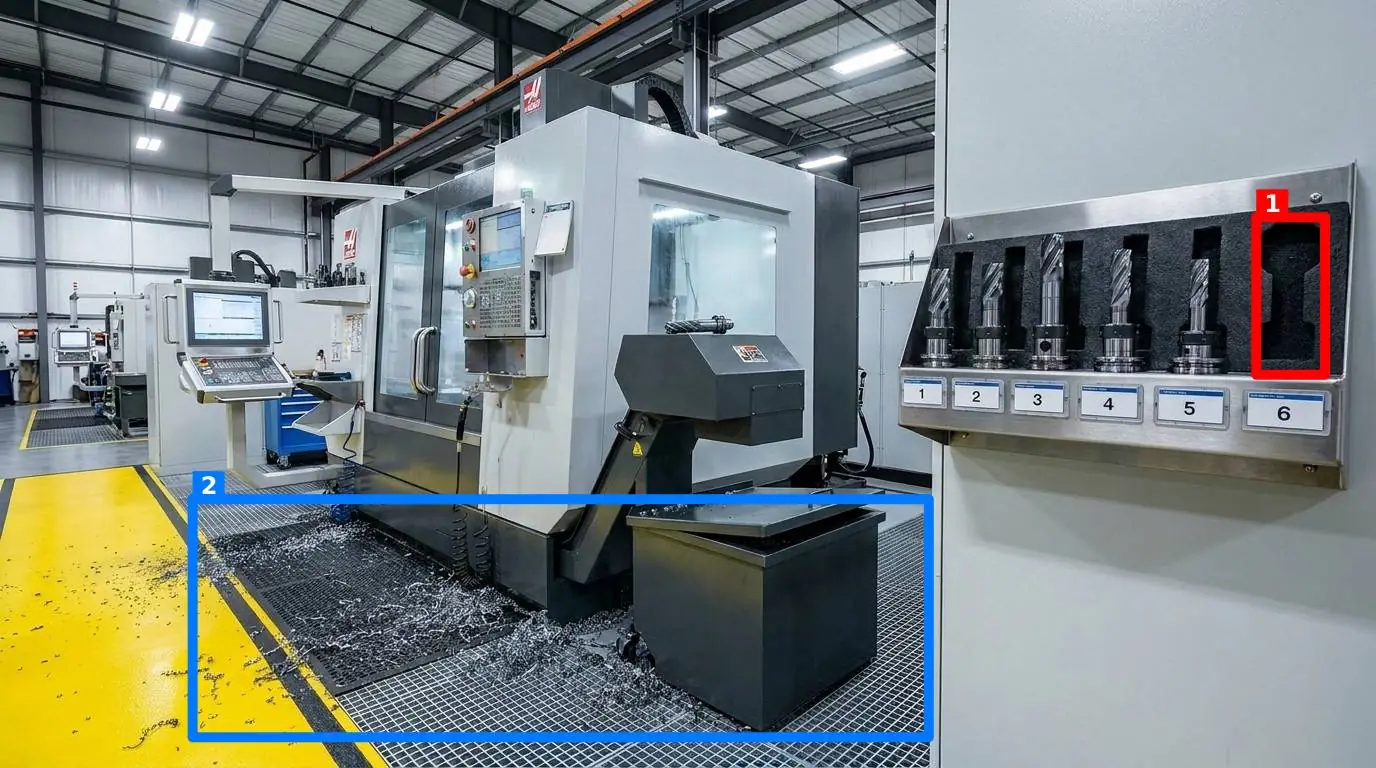
Consider the machine guarding on a CNC line. A standard check might ask, 'Are guards in place?' A visual standard, however, shows exactly where the guard sits and the specific safety interlock that must be engaged. If a worker has bypassed an interlock to speed up a changeover, a simple checklist 'Yes' might still be recorded, but a visual comparison would immediately flag the discrepancy. This level of detail is what prevents the minor oversights that turn into major non-conformances during a formal inspection.
Maintaining Compliance Across the 4 Pillar SMETA Audit Framework
The four pillars are interconnected. A failure in the Environmental pillar, such as a leaking oil drum, is often also a Health and Safety failure due to slip risks. Preparing for a 4 pillar smeta audit requires a holistic view of the floor. You cannot silo these responsibilities. The person responsible for the chemical store must also understand how their housekeeping reflects the site's Business Ethics—specifically, the commitment to providing a safe and dignified workplace for every employee.
The Labour Standards pillar also has a physical component. Auditors will check if mandatory posters, such as minimum wage notices or safety rights, are displayed in the native languages of the workforce. They will look at the break room to see if it is clean and if the drinking water stations are maintained. These are not just 'housekeeping' tasks; they are evidence of your compliance with ethical trade standards. If the break room is a mess, the auditor may infer that the site's commitment to worker welfare is equally neglected.
The Environmental Pillar: Beyond the Policy
Environmental compliance on the floor is about containment and segregation. Auditors will look at your waste streams. Are the bins for hazardous oily rags being used for general lunch waste? Is the secondary containment bund under your outdoor bulk tanks filled with rainwater and leaves, effectively negating its capacity? These are concrete problems that require concrete solutions. You should have a clear, visual 'reference state' for every environmental control point. For instance, a spill kit should not just be 'present'; it should be sealed, with the contents list visible and the path to it clear of any obstructions like empty pallets or floor scrubbers.
Why Traditional Checklists Struggle with SMETA
Many facilities still rely on paper-based checklists or basic digital forms. The problem with these is a phenomenon known as 'pencil-whipping.' When a worker has thirty items to check before they can start their actual job, the temptation to tick 'Yes' across the board is overwhelming. This is one reason why your 5S audit checklist lies to you. It records what should be true, not what is actually happening on the floor at 2:00 AM on a Tuesday.
Paper lacks context. A checkmark next to 'Fire Exit Clear' doesn't tell you if the exit was clear by two inches or ten feet. It doesn't show you the temporary stack of boxes that was moved just as the supervisor walked by. To truly prepare for a 4 pillar smeta audit, you need evidence that is harder to faking and easier to verify. This is where moving toward visual verification becomes a necessity. Using an app for safety inspection visual standards allows you to move away from subjective 'Yes/No' answers and toward objective, photographic proof of the floor's condition.
Moving from Subjective Checks to Visual Evidence
The bridge between 'doing the check' and 'maintaining the standard' is visual evidence. Integrating a tool like SnapAudit into the daily routine changes the dynamic of the floor walk. Instead of a worker ticking a box on a screen, they open a browser on their phone, navigate to a control point, and take a photo. The AI then compares this photo against a reference image you have set—showing the station in its perfect, compliant state. The system looks for five specific criteria: presence of items, cleanliness, clutter, position, and orientation.
If a torque wrench is missing from its shadow board or a fire door is propped open, the AI doesn't just record a failure; it draws a coloured box around the problem on the worker's screen. The worker gets an immediate score out of 100 and a clear message on what to fix. This is not about catching people out; it is about providing instant feedback so the standard can be corrected before the shift even begins. For the manager, this data is invaluable. You can see a Pareto view of which areas or which specific problems—like a recurring blockage in a specific walkway—are your most frequent offenders. This allows you to target your capital expenditure or training efforts where they will have the most impact on your audit score.
| Control Point | Visual Marker for SMETA Compliance | Potential Non-Conformance |
|---|---|---|
| PPE Station | All dispensers full; signage in local languages. | Empty glove box; obstructed access. |
| Chemical Storage | Bunds empty; labels facing forward; MSDS present. | Spills in bund; missing or unreadable labels. |
| Fire Exit | No items within yellow floor markings; door latched. | Pallets stored in 'safe zone'; door propped open. |
| First Aid Kit | Seal intact; no items stored on top of the box. | Broken seal; kit used as a shelf for tools. |
First Steps to Audit Readiness
If you are looking to improve your performance in your next audit, do not start with the paperwork. Start with the floor. The transition from a reactive 'cleanup' culture to a proactive 'standard' culture happens in small, manageable steps. You cannot fix everything at once, but you can ensure that the most critical points are always in a state of compliance.
- Identify your critical control points: Walk the floor and identify the twenty areas most likely to trigger a non-conformance. This usually includes fire safety equipment, chemical storage, LOTO stations, and waste segregation points.
- Establish the 'Perfect State': Clean each of these areas until they are in a state of perfect compliance. Take a high-quality reference photo of each. This is now your official standard.
- Implement a daily visual check: Move away from generic checklists. Require a daily photo of these twenty points. This creates a digital 'paper trail' of compliance that is far more convincing to an auditor than a stack of signed papers.
- Review the Pareto data: Look for the recurring issues. If the same fire door is blocked every Wednesday, find out why. Is that the day the new stock arrives? Does the warehouse need more racking? Fix the root cause, not just the symptom.
By the time the actual 4 pillar smeta audit begins, your team will be used to maintaining these standards as a matter of course. When compliance is visual and feedback is instant, the audit is no longer a source of dread—it is simply a confirmation of the work you do every day. The goal is to reach a point where the auditor's walk-through reveals nothing you haven't already seen and corrected yourself. For more insights on how to handle the complexities of floor-level management, consider why HSEQ management software fails on the floor and how to avoid those common pitfalls.